Older, solid-walled homes
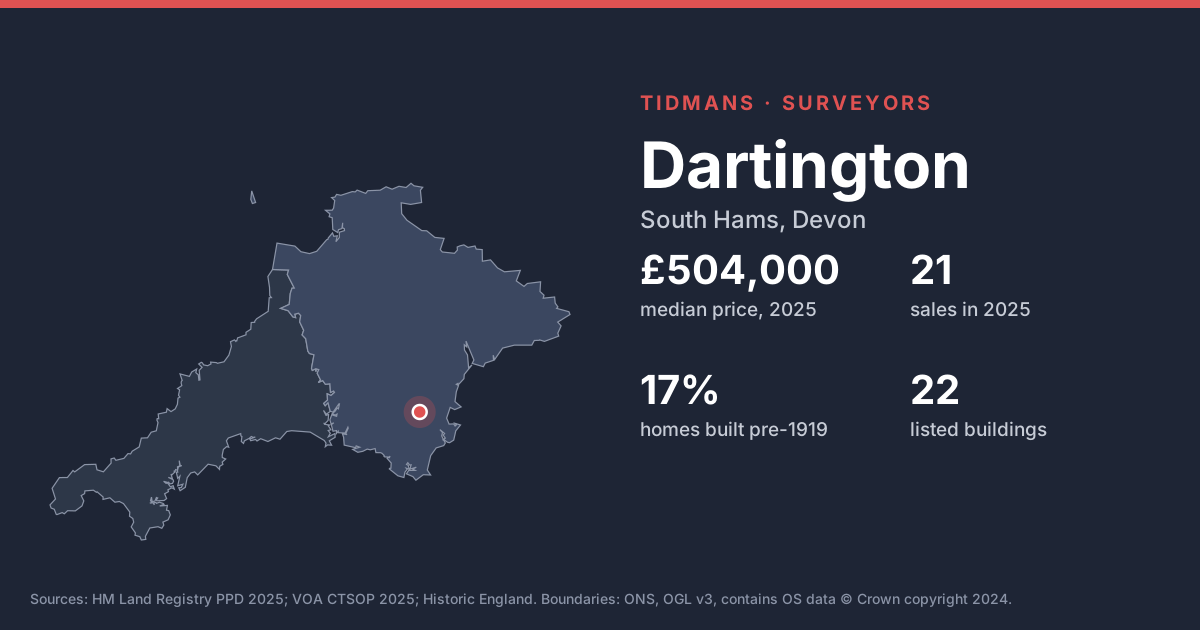
Before-1919 homes make up 17% of the stock here. Solid-walled houses behave differently from modern ones; watch for hard cement pointing and modern coatings that hold moisture in, and treat any 'rising damp' diagnosis from a damp-proofing salesman with caution.
Source: VOA, Mar 2025
Listed buildings
Historic England lists 22 buildings in and around Dartington. Listed status affects windows, renders and repairs, so check what consent exists for work already done.
Source: Historic England
Conservation areas
South Hams District Council's conservation area boundaries aren't published to planning.data.gov.uk, so we can't map them here. Ask your conveyancer or check the council's website if you're planning alterations.
Source: planning.data.gov.uk (no data)
Flood risk (rivers and sea)
1 of the 17 postcodes we checked (postcodes where homes sold in 2025) have their centre in Environment Agency Flood Zone 2 or 3, and 1 in Zone 3. Look up the exact property, not just the postcode, and get an insurance quote early.
Source: Environment Agency
Radon
The 1 km radon map square at the centre of Dartington is class 3: an estimated 3 to 5% of homes are above the radon Action Level. 100% of the sold postcodes we checked fall in a radon Affected Area. Ask the seller for any radon test result, or test after you move in; remedies are usually straightforward.
Source: UKHSA/BGS
Mundic
Mundic (decaying concrete made with mine waste) is mainly a Cornish issue, but lenders also ask about it in parts of Devon such as South Hams. A pre-1950 concrete-block home here may need a mundic test.
Source: RICS
Ground and building stone
Under most of Dartington the bedrock is mudstone, siltstone and sandstone (85%). Older homes are often built of local stone; check pointing, wall heads and chimney stacks.
Source: BGS 625k