Older, solid-walled homes
Plymouth has a large older stock (23% pre-1919). Budget for the things old houses need: repointing, chimney work, timber repairs and sorting out unsuitable modern coatings.
Source: VOA, Mar 2025
Surveyors · Plymouth, Devon
Home surveys in Plymouth: the local risks, the price picture and the right survey level, from a surveyor-led Devon practice.
Our suggestion for Plymouth
About a fifth or more of Plymouth's homes are pre-1919, so the right survey depends on the house. If the house is Victorian or older, listed, or has been heavily extended, go Level 3. Otherwise a Level 2 normally does the job.
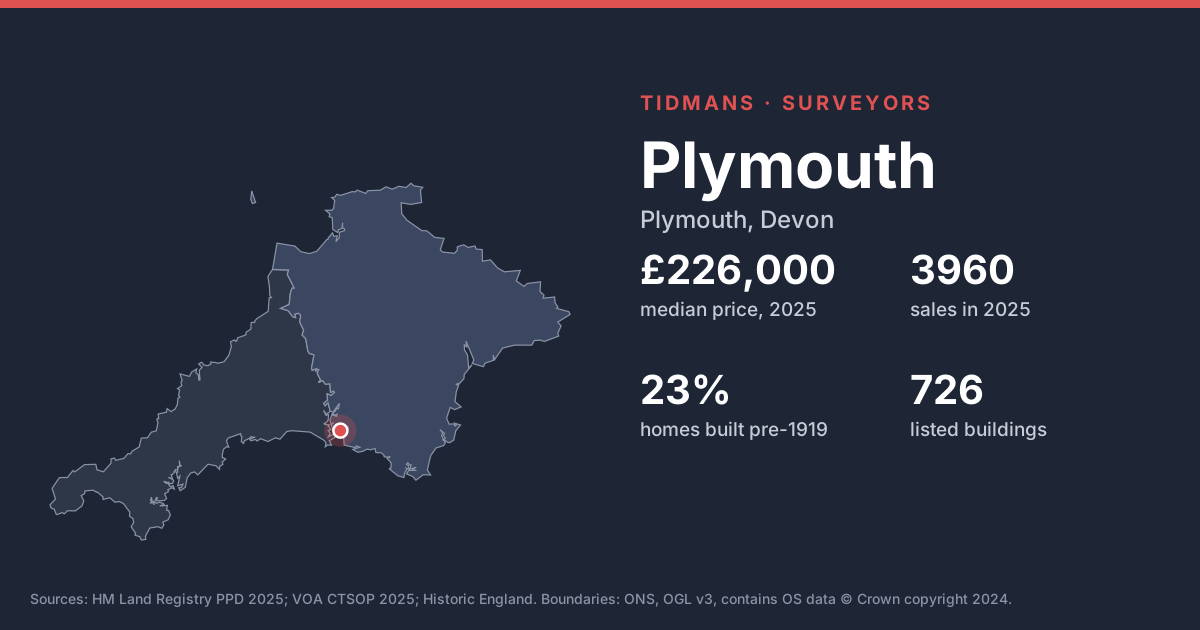
In 2025, 3960 homes sold in Plymouth at a median price of £226,000, up 3% on 2024's £220,000.
| Type | Median |
|---|---|
| detached | £390,000 |
| semi-detached | £260,000 |
| terraced | £210,000 |
| flat/maisonette | £136,500 |
Sales mix: terraced 42%, semi-detached 28%, flat/maisonette 18%, detached 12%. PL1, PL6, PL4, PL5, PL3, PL2, PL7. HM Land Registry, 2025, ONS built-up area. Residents: Plymouth built-up area, ONS Census 2021.
Plymouth has a large older stock (23% pre-1919). Budget for the things old houses need: repointing, chimney work, timber repairs and sorting out unsuitable modern coatings.
Source: VOA, Mar 2025
Historic England lists 726 buildings in and around Plymouth, including Brewhouse, Royal William Victualling Yard (Grade I); Charles Church (Grade I); Church Of St Andrew (Grade I). If the home you're buying is listed, alterations (even past ones) may have needed listed building consent; ask for the paperwork.
List entries: Brewhouse, Royal William Victualling Yard · Charles Church · Church Of St Andrew
Source: Historic England
Conservation areas here: Adelaide Street/Clarence Place, Barbican, City Centre, Devonport, Ebrington Street and others. Inside a conservation area, things like replacement windows and roof changes can need permission, which matters if you're planning work.
Source: planning.data.gov.uk
Only 1 of the 100 postcodes we checked have their centre in Flood Zone 2 or 3. That's rivers and sea only; surface water is mapped separately, so still check the address.
Source: Environment Agency
The 1 km radon map square at the centre of Plymouth is class 3: an estimated 3 to 5% of homes are above the radon Action Level. 98% of the sold postcodes we checked fall in a radon Affected Area. A three-month radon test is cheap, and fixes (often a sump or better underfloor ventilation) are well understood.
Source: UKHSA/BGS
Mundic (decaying concrete made with mine waste) is mainly a Cornish issue, but lenders also ask about it in parts of Devon such as Plymouth. A pre-1950 concrete-block home here may need a mundic test.
Source: RICS
Under most of Plymouth the bedrock is mudstone, siltstone and sandstone (84%). Older homes are often built of local stone; check pointing, wall heads and chimney stacks.
Source: BGS 625k
The BGS GeoSure 5 km hexagon covering Plymouth shows moderate slope instability (landslides) potential. That's a broad screen, not a site assessment; look for cracking, sticking doors and leaning walls.
Source: BGS GeoSure
At roughly 0.1 km from the open sea, exposure matters: check render, chimneys, window seals and metalwork for salt and weather damage.
Source: Natural Earth
19% of 2025 sales in Plymouth were leasehold. Check the lease length, ground rent, service charges and any planned major works before you commit.
Source: HM Land Registry
Plymouth LSOAs with 2025 sales. VOA, Mar 2025.
For Plymouth sellers, 2025 medians were detached £390,000, semi-detached £260,000, terraced £210,000, flat/maisonette £136,500. A free, in-person appraisal tells you where yours sits.
Need an EPC in Plymouth? EPCs in Plymouth. Request a quote for your sale or let.
Based on HM Land Registry Price Paid Data, 3960 homes sold in Plymouth in 2025 with a median price of £226,000 (up 3% on 2024's £220,000). The most common type sold was terraced (42% of sales).
We carry out RICS Level 2 and Level 3 surveys. Which you need depends on the age and type of the house. 23% of homes in the 169 neighbourhoods where Plymouth homes sold were built before 1919. 726 listed buildings in and around Plymouth, 99 of them Grade I or II*. The house itself decides it, so use the chooser or ask us.
Largely, yes. The central square is class 3, meaning 3 to 5% of homes are estimated above the Action Level, and 98% of checked postcodes are affected.
1 out of 100 checked Plymouth postcodes sit in Flood Zone 2 or 3, 1 of them in Zone 3. That's river and sea flooding; surface water is separate.
Historic England's list shows 726 listed buildings in and around Plymouth: 23 Grade I, 76 Grade II* and 627 Grade II.
Online, in a couple of minutes: Survey Booker gives an instant price for Plymouth homes. You can also call us.