Older, solid-walled homes
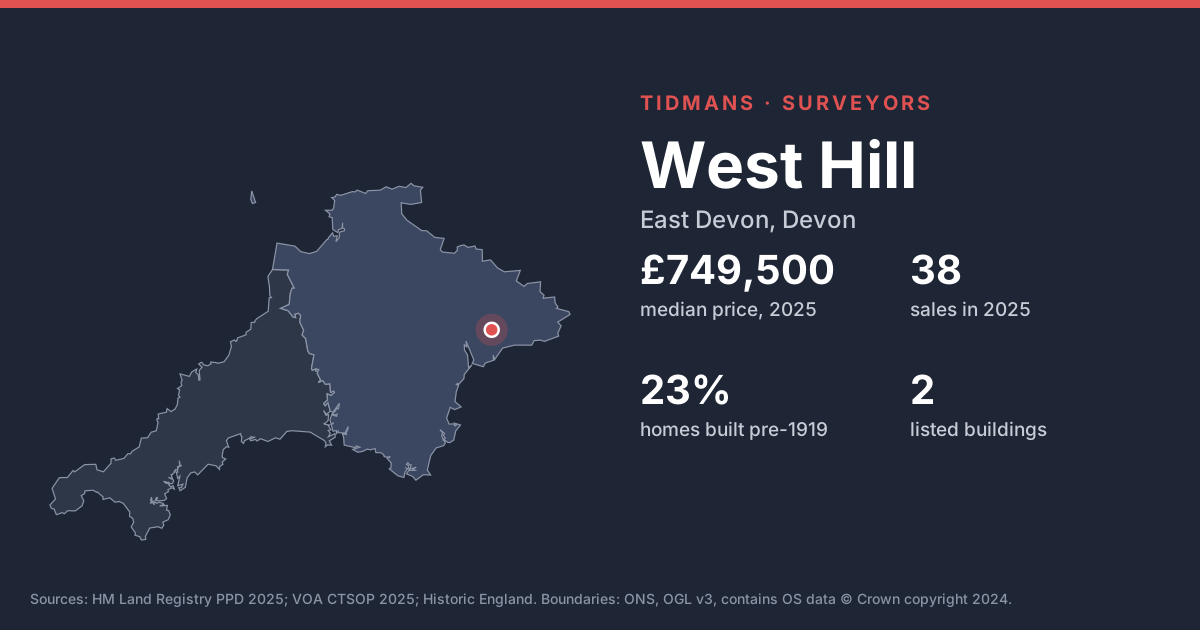
23% of the housing stock in these neighbourhoods dates from before 1919 and 22% from before 1900. Expect solid walls rather than cavities, so damp diagnosis needs care: cement renders, plastic paints and raised ground levels trap moisture in walls that were designed to breathe.
Source: VOA, Mar 2025
Listed buildings
Historic England lists 2 buildings in and around West Hill. Listed status affects windows, renders and repairs, so check what consent exists for work already done.
Source: Historic England
Flood risk (rivers and sea)
Only 0 of the 27 postcodes we checked have their centre in Flood Zone 2 or 3. That's rivers and sea only; surface water is mapped separately, so still check the address.
Source: Environment Agency
Radon
The radon map square at the centre of West Hill is class 1 (under 1% of homes above the Action Level), though 41% of the sold postcodes we checked are in an Affected Area.
Source: UKHSA/BGS
Ground and building stone
Under most of West Hill the bedrock is interbedded sandstone and conglomerate (100%). In Devon, older homes on this ground are often cob (earth walls) or local stone; cob must stay dry, so look hard at renders, gutters and ground levels.
Source: BGS 625k
Ground stability
The BGS GeoSure 5 km hexagon covering West Hill shows moderate shrink-swell clay, significant slope instability (landslides) potential. That's a broad screen, not a site assessment; look for cracking, sticking doors and leaning walls.
Source: BGS GeoSure