Older, solid-walled homes
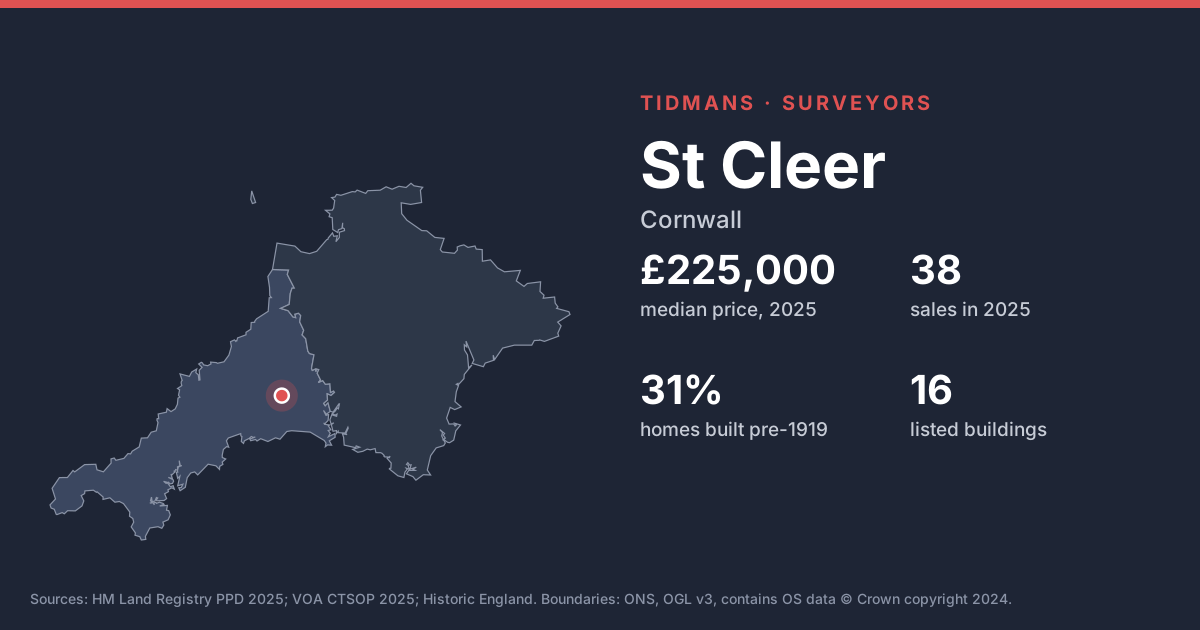
31% of the housing stock in these neighbourhoods dates from before 1919 and 30% from before 1900. Expect solid walls rather than cavities, so damp diagnosis needs care: cement renders, plastic paints and raised ground levels trap moisture in walls that were designed to breathe.
Source: VOA, Mar 2025
Listed buildings
Historic England lists 16 buildings in and around St Cleer, including Church Of St Clarus (Grade I); St Cleer'S Well And Wall (Grade I); Bible Christian Chapel (Grade II*). On a listed home, like-for-like repairs with traditional materials are the rule; your surveyor should flag anything that looks unconsented.
List entries: Church Of St Clarus · St Cleer'S Well And Wall · Bible Christian Chapel
Source: Historic England
Flood risk (rivers and sea)
River and sea flood risk is limited here: 0 of 24 sampled postcodes fall in Zone 2 or 3. Surface-water risk is a separate map worth a look.
Source: Environment Agency
Radon
The 1 km radon map square at the centre of St Cleer is class 6: an estimated 30% or more of homes are above the radon Action Level. 100% of the sold postcodes we checked fall in a radon Affected Area. Ask the seller for any radon test result, or test after you move in; remedies are usually straightforward.
Source: UKHSA/BGS
Mining and mundic
St Cleer lies inside the Cornwall and West Devon Mining Landscape World Heritage Site. Expect your conveyancer to order a mining search, and if the home has pre-1950 concrete blocks, a mundic test may be a lender condition.
Source: UNESCO WHS; RICS
Ground and building stone
Under most of St Cleer the bedrock is mudstone, siltstone and sandstone (100%). This is the 'killas' country of slate and shale; older homes are often rubble stone, sometimes slate-hung, and weathering of soft stone and mortar is common.
Source: BGS 625k