Older, solid-walled homes
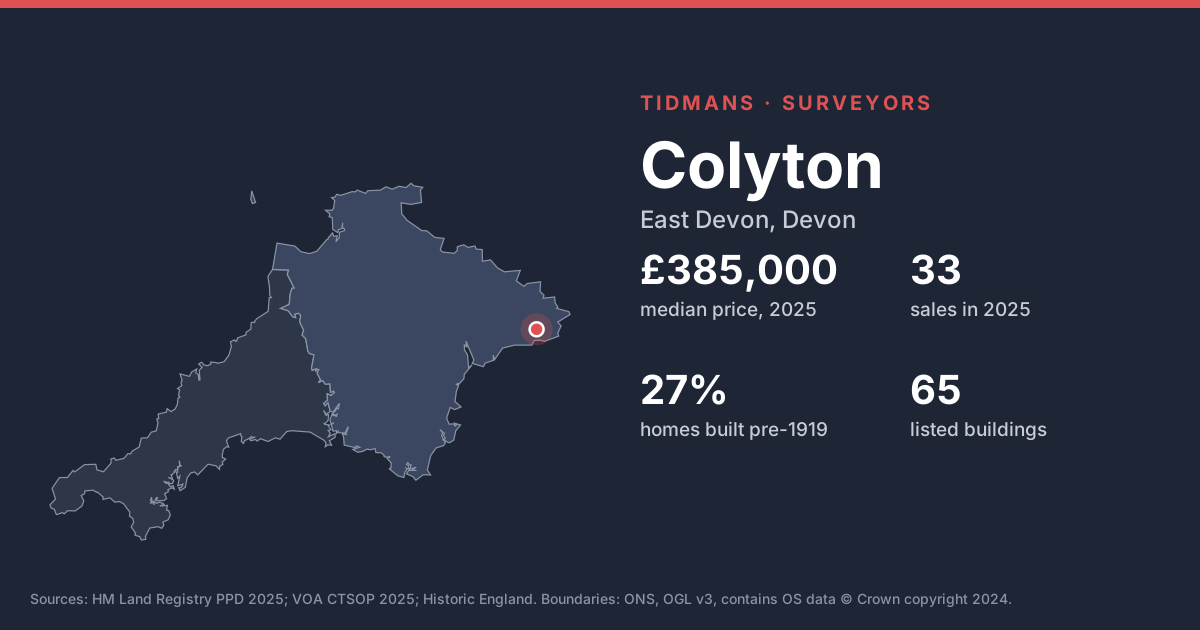
27% of the housing stock in these neighbourhoods dates from before 1919 and 26% from before 1900. Expect solid walls rather than cavities, so damp diagnosis needs care: cement renders, plastic paints and raised ground levels trap moisture in walls that were designed to breathe.
Source: VOA, Mar 2025
Listed buildings
Historic England lists 65 buildings in and around Colyton, including Church Of St Andrew (Grade I); Great House (Grade II*). Listed status affects windows, renders and repairs, so check what consent exists for work already done.
List entries: Church Of St Andrew · Great House
Source: Historic England
Conservation area
Conservation area here: Colyton. If you plan changes, check with the council first: conservation area rules limit what you can do without permission.
Source: planning.data.gov.uk
Flood risk (rivers and sea)
3 of the 30 postcodes we checked (postcodes where homes sold in 2025) have their centre in Environment Agency Flood Zone 2 or 3, and 0 in Zone 3. Check the specific address on the government's flood risk service and get insurance quotes before exchange.
Source: Environment Agency
Radon
The radon map square at the centre of Colyton is class 1 (under 1% of homes above the Action Level).
Source: UKHSA/BGS
Ground and building stone
Under most of Colyton the bedrock is mudstone, siltstone and sandstone (100%). Local stone is common in older houses, so pointing, chimney stacks and the tops of walls deserve a close look.
Source: BGS 625k
Ground stability
The BGS GeoSure 5 km hexagon covering Colyton shows moderate shrink-swell clay, significant slope instability (landslides), significant soluble rocks (dissolution) potential. That's a broad screen, not a site assessment; look for cracking, sticking doors and leaning walls.
Source: BGS GeoSure