Older, solid-walled homes
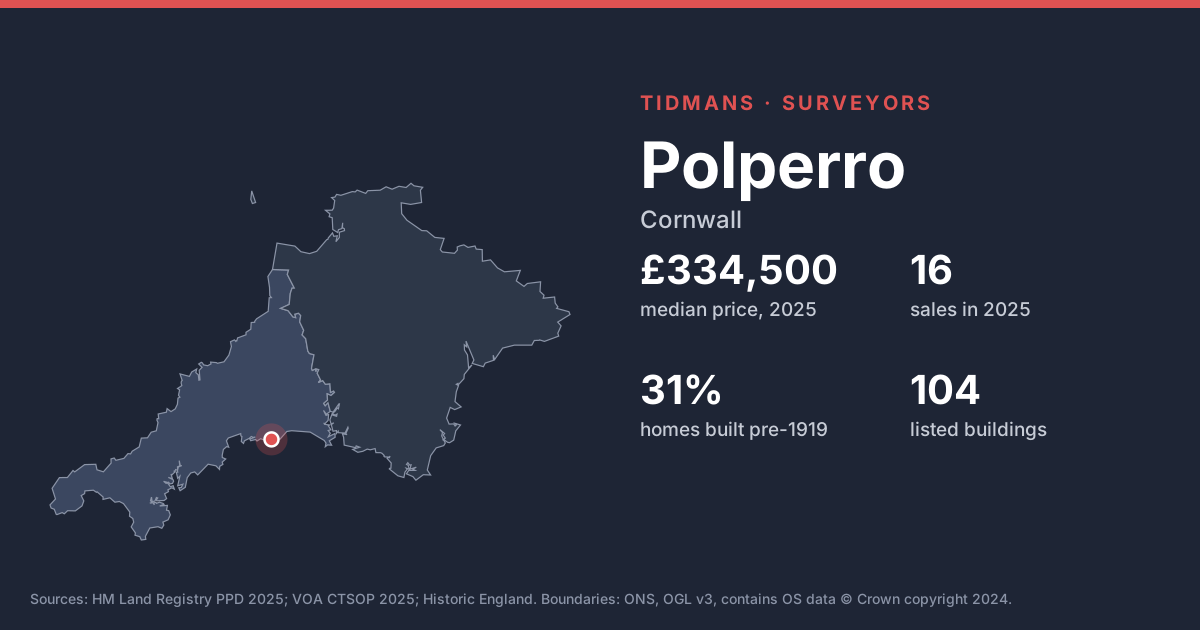
Before-1919 homes make up 31% of the stock here. Solid-walled houses behave differently from modern ones; watch for hard cement pointing and modern coatings that hold moisture in, and treat any 'rising damp' diagnosis from a damp-proofing salesman with caution.
Source: VOA, Mar 2025
Listed buildings
Historic England lists 104 buildings in and around Polperro. Buying a listed home? Ask the seller for consents for any past alterations, as unauthorised works stay with the building.
Source: Historic England
Conservation area
Conservation area here: Polperro. If you plan changes, check with the council first: conservation area rules limit what you can do without permission.
Source: planning.data.gov.uk
Flood risk (rivers and sea)
4 of the 16 postcodes we checked (postcodes where homes sold in 2025) have their centre in Environment Agency Flood Zone 2 or 3, and 3 in Zone 3. Look up the exact property, not just the postcode, and get an insurance quote early.
Source: Environment Agency
Radon
The 1 km radon map square at the centre of Polperro is class 5: an estimated 10 to 30% of homes are above the radon Action Level. 100% of the sold postcodes we checked fall in a radon Affected Area. Check whether the house has a radon sump or membrane, and if there's no test result, plan one in the first year.
Source: UKHSA/BGS
Mining and mundic
A mining search is standard practice in Cornwall, and pre-1950 concrete construction can trigger a mundic test (RICS guidance).
Source: UNESCO WHS; RICS
Ground and building stone
Under most of Polperro the bedrock is mudstone, siltstone and sandstone (100%). This is the 'killas' country of slate and shale; older homes are often rubble stone, sometimes slate-hung, and weathering of soft stone and mortar is common.
Source: BGS 625k
Coastal exposure
At roughly 0.4 km from the open sea, exposure matters: check render, chimneys, window seals and metalwork for salt and weather damage.
Source: Natural Earth