Older, solid-walled homes
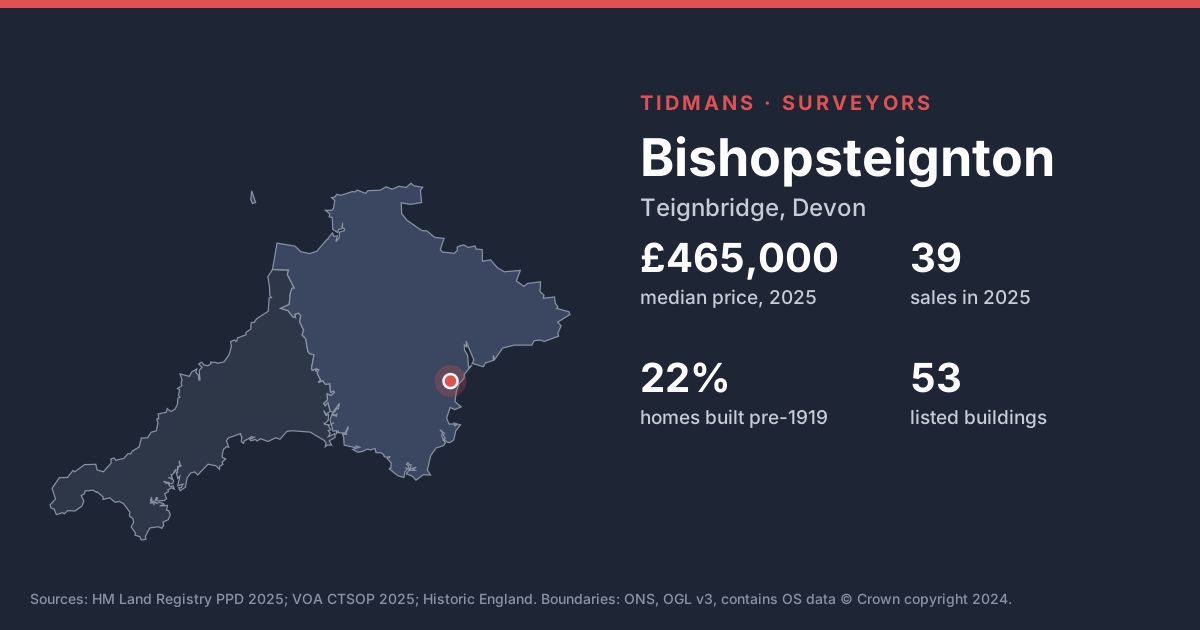
Before-1919 homes make up 22% of the stock here. Solid-walled houses behave differently from modern ones; watch for hard cement pointing and modern coatings that hold moisture in, and treat any 'rising damp' diagnosis from a damp-proofing salesman with caution.
Source: VOA, Mar 2025
Listed buildings
Historic England lists 53 buildings in and around Bishopsteignton, including Church Of St John The Baptist (Grade I); Cross House (Grade II*); Green (Grade II*). Buying a listed home? Ask the seller for consents for any past alterations, as unauthorised works stay with the building.
List entries: Church Of St John The Baptist · Cross House · Green
Source: Historic England
Conservation area
Conservation area here: Bishopsteignton. Permitted development rights are narrower inside a conservation area, so extensions, windows and solar panels may need planning permission.
Source: planning.data.gov.uk
Flood risk (rivers and sea)
Only 0 of the 33 postcodes we checked have their centre in Flood Zone 2 or 3. That's rivers and sea only; surface water is mapped separately, so still check the address.
Source: Environment Agency
Radon
The 1 km radon map square at the centre of Bishopsteignton is class 3: an estimated 3 to 5% of homes are above the radon Action Level. 100% of the sold postcodes we checked fall in a radon Affected Area. A three-month radon test is cheap, and fixes (often a sump or better underfloor ventilation) are well understood.
Source: UKHSA/BGS
Ground and building stone
Under most of Bishopsteignton the bedrock is mudstone, siltstone and sandstone (62%) and interbedded sandstone and conglomerate (26%). Cob (earth walling) is a traditional Devon material; it needs to breathe and stay dry, so cement render, blocked gutters and raised paths are red flags.
Source: BGS 625k